Studies
Self-initiated work, built to client standard.
Client work shows what I made for someone else. Studies show how I think when I set the brief myself. Each one is a complete, working website for an organization I invented, labelled plainly as fictional, and written up the way I write up client work: the brief, the decisions, the measurements, and what still needs fixing.
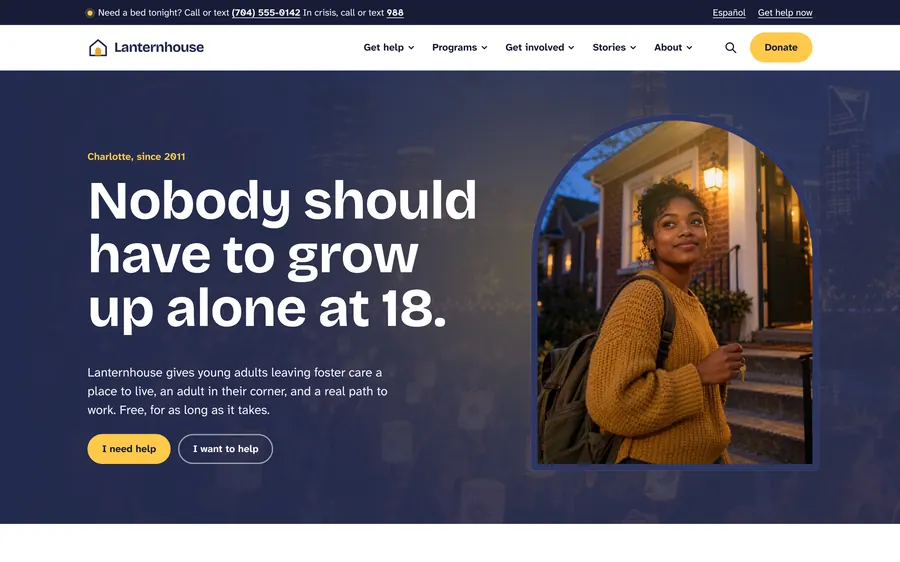 Self-initiated study Nonprofit · Youth services
Lanternhouse
A complete website for a fictional Charlotte nonprofit, designed first for a 19-year-old on a cracked phone at night.
Read the study
 Self-initiated study Higher education
Turia Institute
A university site for a fictional institute in Valencia, rebuilt after studying four European universities.
Read the study
Method
How a study runs, start to finish.
The same six steps I bring to a client engagement. A study simply lets you see all of them, with nothing held back for confidentiality.
- 01
Brief
Written as a client would hand it over: audiences, scope, success criteria, and the guardrails that matter before anything is drawn.
- 02
Research
References and benchmarks, studied side by side and credited by name. What I chose not to adopt is written down too.
- 03
System
Identity, type, colour, motion and components grown from one idea, so every page belongs to the same place.
- 04
Build
Every page the brief implies, generated from one content file. Working links, forms, search and phones, not a set of pictures.
- 05
Measure
Accessibility, performance, privacy and mobile, checked on real browsers. The numbers go in the write-up, including the ones that failed.
- 06
Write it down
What I learn becomes a rule for the next project. Turia started with the motion rules Lanternhouse taught me.
Why both
Client work and studies prove different things.
What client work proves
That I can deliver inside real constraints: budgets, boards, deadlines, legacy systems and live traffic. The In Safe Company and Urban League case studies are the evidence.
What studies add
Range across sectors and visual languages, the whole process in the open, and experiments that become standards. They are not mockups: every study is a site you can open, click through and test on your own phone.